FROM ROMFORD TO…
GUIDEA PARK


Conservation area. Street signs


South

North

Around MAIN ROAD


As usual, a HIDDEN LONDON post makes a good intro
Predominantly an affluent and residential area, approximately 15 miles (24 km) east of Charing Cross, it was historically located in the county of Essex. It saw significant expansion in the early 20th century, with exhibitions of housing and town planning (the first being known as Romford Garden Suburb) and the construction of a railway station on the main line out from London Liverpool Street station.
Thomas Cooke, a Suffolk man who became London Mayor in 1462, was granted a Royal Charter for Royal Liberty of Havering-atte-Bower, which enabled him to build a country house, which he named "Geddy Hall". The word "geddy" was so named after the lake and its livestock; ged (meaning pike) and ea (water). The house remained unfinished for at least a century, because of his numerous incarcerations in the Tower of London for high treason. Upon his death in 1478, the estate was passed down through the Cooke family and eventually to his great-grandson, Anthony Cooke, who was a tutor for Edward VI.[1] After a brief period abroad, Anthony returned to Havering-atte-Bower and completed the building of Geddy Hall, which later became Gidea Hall.
In 1909 Herbert Raphael, John Tudor Walters and Charles McCurdy, three Liberal Members of Parliament(MPs) who had links with the Hampstead Garden Suburb development, formed a company with the objective of building a new garden suburb on the Gidea Hall estate. Raphael also reached agreement with the Great Eastern Railway for a new station on the main line from London Liverpool Street to serve the new suburb.[4]
Romford Garden Suburb was constructed between July 1910 and June 1911 on the Gidea Hall and Balgores estates (respectively north and south of Hare Street, now called Main Road) as an exhibition of town planning.
More about the 1911 Exhibition


More about the 1930s exhibition
A further 35 houses, mostly of contemporary flat-roofed design, were built in 1934–35 in Heath Drive, Brook Road, and Eastern Avenue for a Modern Homes Exhibition.

The Royal Liberty School in Upper Brentwood Road was the first school in Britain (and possibly in Europe) to install an electronic computer (an Elliot 903), similar to the 920 military version) in 1965.
The original HARE HALL
It was built in 1769–70 as a country house for John A. Wallinger and since 1921 has housed the Royal Liberty School.
The Palladian mansion was built to designs by James Paine, who included it in his published Plans.[1] The main north front is of five bays, with a rusticated basement storey, above which the two upper storeys are unified by a giant portico and pilasters at the angles.
Attached to the south front by short corridors there were pavilions containing service rooms. The principal rooms were on the first floor, and were approached by a central staircase with curved ends and a wrought iron balustrade.
The main front was of Portland stone, but the south front was of red brick. In 1896 the house was considerably enlarged on that side by filling in the space between the pavilions.
At the stud maintained at Hare Park, Cherimoya, foaled in 1908, was bred by the South African mining entrepreneur and horseman William Broderick Cloete; after Cloete's death in the sinking of the Lusitania,[2] during the First World War Hare Park became Hare Hall Camp and housed the 2nd Battalion of the Artists Rifles.

FROM havering museum TO raphael park
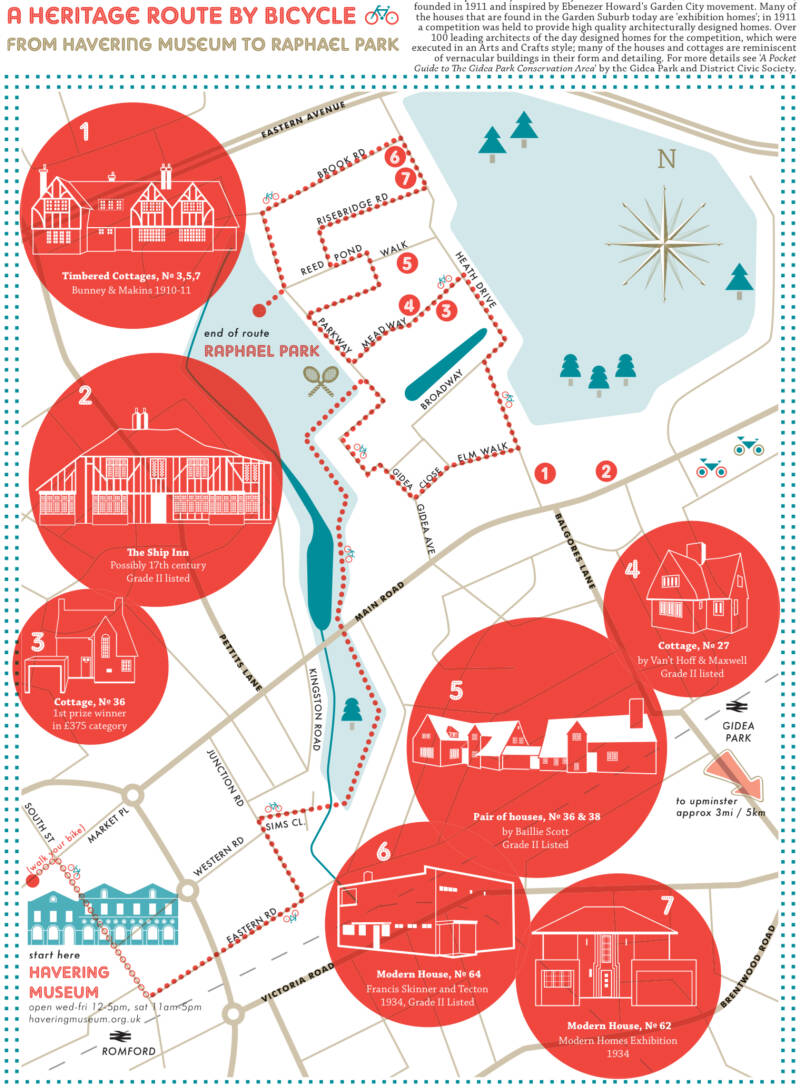
Tis pleasant cycle will take you around Gidea Park, Romford's Garden Suburb,
founded in 1911 and inspired by Ebenezer Howard's Garden City movement. Many of
the houses that are found in the Garden Suburb today are 'exhibition homes'; in 1911
a competition was held to provide high quality architecturally designed homes. Over
100 leading architects of the day designed homes for the competition, which were
executed in an Arts and Crafts style; many of the houses and cottages are reminiscent
of vernacular buildings in their form and detailing. For more details see 'A Pocket
Guide to Te Gidea Park Conservation Area' by the Gidea Park and District Civic Society.
To the South of ROMFORD
The old HAVERING WELL, now RONEO CORNER
ROM SKATEPARK

The country’s best-known